Wednesday, June 4, 2014

A Day in Gonder, Ethiopia

Arriving in Gonder, we are greeted with views of a beautiful city. The air feels cooler and there is more humidity in the air than there was in Lalibella and Axum. Our hotel sits atop a hill and provides us with a beautiful view of the city including the palace compound of King Fasiledes.

In fact, our first stop during our short one day stay in Gonder takes us to this compound. King Fasiledes and his family ruled in the 1600's and 1700's and the compound includes six separate castles, each built by different royals, at different times, and for different reasons. For instance, one of the castles is visibly more humble than the others and this one was built by one of the royals who had a sense of humility and intellectual pursuits, therefore he also built a library next to his humble palace.

It was almost like wandering through a medieval feudal small kingdom. Even though the castles here were not built during what the west traditionally would consider “medieval” they were built at a time when the feudal structure was similar to the feudal structure that was present in Europe during the traditional “medieval” period.

After leaving the palace compound we toured the king's bath-house. This is a small castle-like structure surrounded by a pool that is as deep as the castle is high. During the rainy season, water collects in the pool and there are also structures built in that allow water to be diverted from a local river and into the bath-house. In the present-day, there are bleachers built around the outside and the pool is filled during a certain festival and townspeople come and there is a large celebration with some swimming.

We also visited the main church that was built around the same time. The church was similar to many of the other traditional orthodox churches we have seen. One difference was that upon entering we saw a couple who had just gotten married and were taking pictures in the usual accoutrement of an Ethiopian wedding. Both the Bride and Groom wear white, and have cloaks that surround them. Each wears a distinctive headpiece, resembling a combination of both a crown and a turban.

While visiting the church, I was surprised when a group of three young children came into the church. Normally, when foreigners are present, time is spent answering their questions, taking pictures and asking for alms. However, when the three local children entered, the head Priest immediately paid attention to them, listening to them, talking with them, praying with them and ignoring our presence, allowing us to meander at our own pleasure. This was refreshing. The spiritual journey of the parishioners seemed to be the most important priority for this priest and the children seemed to be much better off in this sense, they were the priority. Is it not Christ who would ignore the needs of the cultures priorities for the sake of those without priority? Is it not Christ who would ignore the rich and powerful in order to show that God favors the poor and the outcast?

I know we say that we focus on the poor fin our churches, but sometimes I feel like that is just something we tell ourselves to make ourselves feel better, especially when many of the decisions we make, many of the plans we strategize about, especially when many of the discussions we have and memories we get nostalgic about in the church are very much a reflection of the opposite of the Gospel's tendency and God's favor of the poor, the lesser, the least.


Tuesday, June 3, 2014

Videos from Ethiopia

Views of the Castle of Fasiledes in Gonder, Ethiopia

Another view of the Castles of Fasiledes in Gonder


We passed a wedding party on the road around Gonder. Very different from what we would see in the USA so I wanted to put it here for everyone's enjoyment. Weddings are joyful experiences, so maybe we should expect them to be jubilant enterprises.
An amazing place. This "primitive village" is actually the housing for a seminary of the Ethiopian Orthodox Church. The students live in the huts - five per hut - and share everything amongst them equally. They live here for a few years.

Finally, a video of some monkeys we saw on the road outside Bahir Dar. Cute video, especially for my kids. I love you Ian and Mia!!! See you soon!!!

A few more pictures.

Pictures. Pictures. Pictures.

View from the Hotel of the Castle of King Fasiledes.
Terrace and view at our hotel in Gonder, Ethiopia.
Castle in King Fasiledes compound.

Another of the six castles in Gonder. These castles were built in the 1600's and 1700's.

Wedding Picture of a couple getting married while we visited one of the Churches in Gonder. 
This village, believe it or not, is for seminary students who live five in a hut, share all property and work together in all living tasks and expenses. Many will do this for multiple years.

Family living in a small town between Gonder and Bahir Dar who showed us how they make injera, a local bread used as a staple for most meals.
The pot used to cook the injera over a fire of dung and wood.
Carl and Jason keeping up the tempo with a cool beat!

The point where Lake Tana flows into the very beginning of the Blue Nile. The Blue Nile then meanders up into Sudan meeting with the White Nile in Khartoum, the Sudanese Capital and then flows north into Egypt and the Mediterranean.
Pastor Steve in front of Africa's second most famous falls. The Blue Nile Falls, near the very beginning of this miraculous river in an amazing landscape.


Sunday, June 1, 2014

Axum: The Ancient Capital of Ethiopia

Axum

The next stop on our tour of Ethiopia took us to Axum, the ancient capital of Ethiopia. This city is in the heart of the Tigray province in the far north, about 40 kilometers from the border with neighboring Eritrea. It is hotter here, and Axum is much larger than Lalibella.
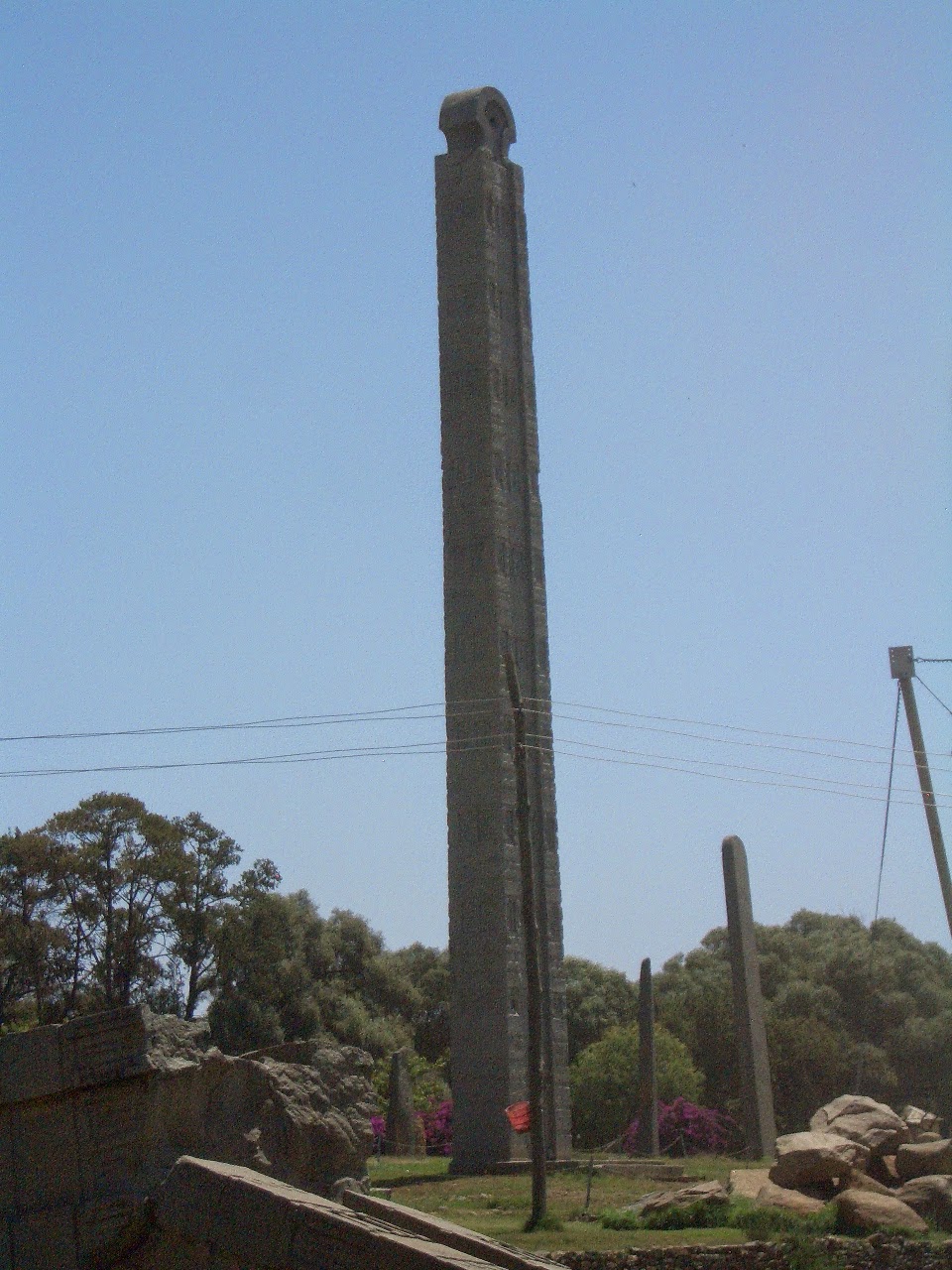
One of the Stelae at Axum


Our days were filled with seeing the sights in and around the city. Axum is famous for a number of reasons, but one the the most well known is for the stelae fields. At the time of Axum's prominence, the area under Axumite control was much of present-day Ethiopia, as well as Eritrea, part of Sudan and even Yemen, on the other side of the Gulf of Aden. The kings that ruled from Axum traditionally would construct obelisks which would, to a certain extent, serve as their tombstones. Looking at the Stelae shows the changes that took place during the reign of the Axumite kingdom. Many stelae are very old and so the those stelae are rather unimpressive. However, there are others that are magnificent, rising around 10 stories in the air and carved designs in granite which was quarried from about 5 miles away and brought to the sites with the help of elephants. Beneath the stelae are a number of tombs where archaelogists have found various treasures, pieces of pottery, and other common findings in tombs like these. During the period shortly before World War II, Italy found itself in control of what is today Eritrea and certain parts of present-day Ethiopia. In Axum, Mussolini broke one of the most important Stelae into three pieces and took it to Rome where it stood for a number of years. It wasn't until fairly recently (a little less than a decade) that this particular stelae was returned to its original place and carefully put back together. One of the interesting pieces of this history we found in the tomb area. There is a casket that has been found in one of the tombs below the stelae fields. It is unknown who is entombed in this casket, except it is assumed one of the Kings is there. However, the casket is made of granite and there is no seal. It appears to be one solid piece of Granite, no way to open it. However, the interesting thing is that it is hollow. There is something inside, but there is no real way to figure out what is inside without breaking the granite apart.

Our guide banging on the casket of one of the Kings to show us that it is hollow.
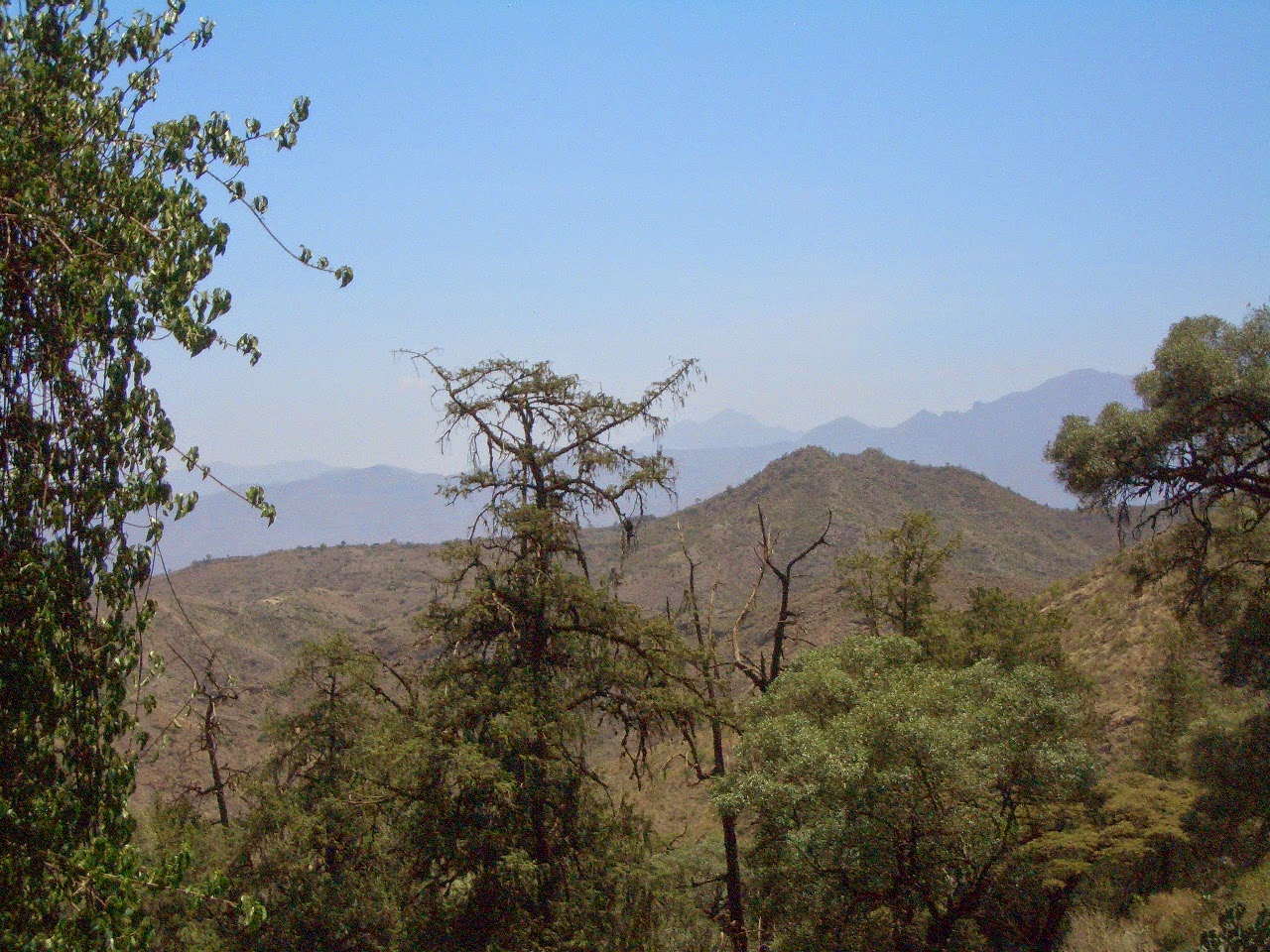
We enter the Simien mountains on the road toward the border with Eritrea.
Axum is also the purported home of the real Ark of the Covenant, the home of the tablets God gave to Moses on which are inscribed the Ten Commandments. All Ethiopian Orthodox churches have a replica of the Ark in their own “holy of holies.” However, St. Mary's church in Axum is where, according to legend, the real ark is housed. There are only a few people who are allowed to actually see it. We were lucky enough to spend some time with one of the former Chief Priests of St. Mary's. His family has been in charge of the Ark for generations. We, of course, were not allowed to see the Ark. Not suprising, but almost all Ethiopians believe that the real Ark is indeed housed here and that belief has affected the course of Ethiopian politics, society, and religion for the past couple thousand years.

We also went to a small town about 60 kilometers away to see the ruins of the city of Yeha. Here there are ruins that date back 2500 years. The temple, which has been somewhat reconstructed, is open and upon entering, one sees the outline of the different rooms, including the rooms where Ibek's, a local type of deer, were sacrificed. In addition, the site contains other interesting things to see.
The Simien Mountains rise above on the way to Yeha.

Pastor Steve at the ruins of Yeha with a camel in the town square.
A young girl selling a traditional Ethiopian Coffee Jar
The ruins of the Temple at Yeha, a pre-Christian sit
It is definitely different than seeing a horse on the side of the road.
The children here are really great, but they are salesmen and saleswomen at heart and do not take no for an answer. However, occasionally one encounters a kid who just wants to practice their English or make a friend with someone from a foreign realm. Traveling to Yeha and back to Axum took us through the Simien Mountains. Beautiful peaks that rise up at least two thousand feat and more but that are not really connected to each other. I see a flat plain with these huge rocky spikes rising up from the flatland, each one freely standing on its own. I have never seen mountains like that, it gives me a sense of total awe at God's marvelous and diverse creation.
The ruins of the palace of the Queen of Sheba


Finally, we headed out to see the remains of the palace of the Queen of Sheba. The site, apparently, is not the actual palace of this famous Queen. The ruins date back to the 5th or 6th century after Christ, much to recent to be from the Queen of Sheba who is believed to have lived around the 10th century BC. However, as archaeologists have excavated the palace, they have found that below what is there now is a different foundation that is much older. One of the current theories then, is that the site is indeed the location of the palace of the Queen of Sheba, however that palace was either destroyed or otherwise abandoned and later another palace was built by another royal and that second palace is the one whose ruins are visible today.

I was taken aback while at this palace to run into an Argentine doctor who is working for a Spanish non-profit in the Horn of Africa. We talked for a bit and I had to laugh that I would come the whole way here to find an Argentine. God always has those little surprises for us, coincidences or not!

As we went back to the hotel, we were accosted by a barrage of children looking for either a sale, a handout, or a handshake. These kids, though, were very adept at dividing us up to conquer us individually and many of us fell for the ruse. However, I did help one kid who showed me his report card, proud of his good grades. However, he worried because he couldn't go to the next grade without a new uniform, so I helped him out by taking him to the tailor and paying a small amount to help him cover the cost. It wasn't much, but it felt good to help him advance his studies. I worry that it was all a ruse and that I got conned, but I am going to convince myself that what I did was the right thing to do, either way, it made me feel good, even though the act of charity was small compared with the need around us.


As I write this, we are at the airport in Axum, waiting to board our plane to the city of Gondar where we will spend the next day and after which we will drive to the city of Bahir Dar which will take us around Lake Tana (the largest lake in Ethiopia) and will provide us the opportunity to take a boat ride on the Blue Nile. I am excited to see that.  
Saturday, May 31, 2014

More pictures from Ethiopia.

Local resident girl coming to see who this group of visitors is.

Inside one of the Rock-hewn churches.

Outside of the largest church.

Some churches are free standing, and others are carved into rock walls. This is one that is carved into the rock.


Monk standing at the entrance of the Church of St. Mary.

Inside carved rock and wood make for beautiful decorations, all of which are highly symbolic. This one is very rare, a Star of David with a Cross inside. Ethiopian Orthodox Christianity blends together both Old and New Testament in a very unique way.
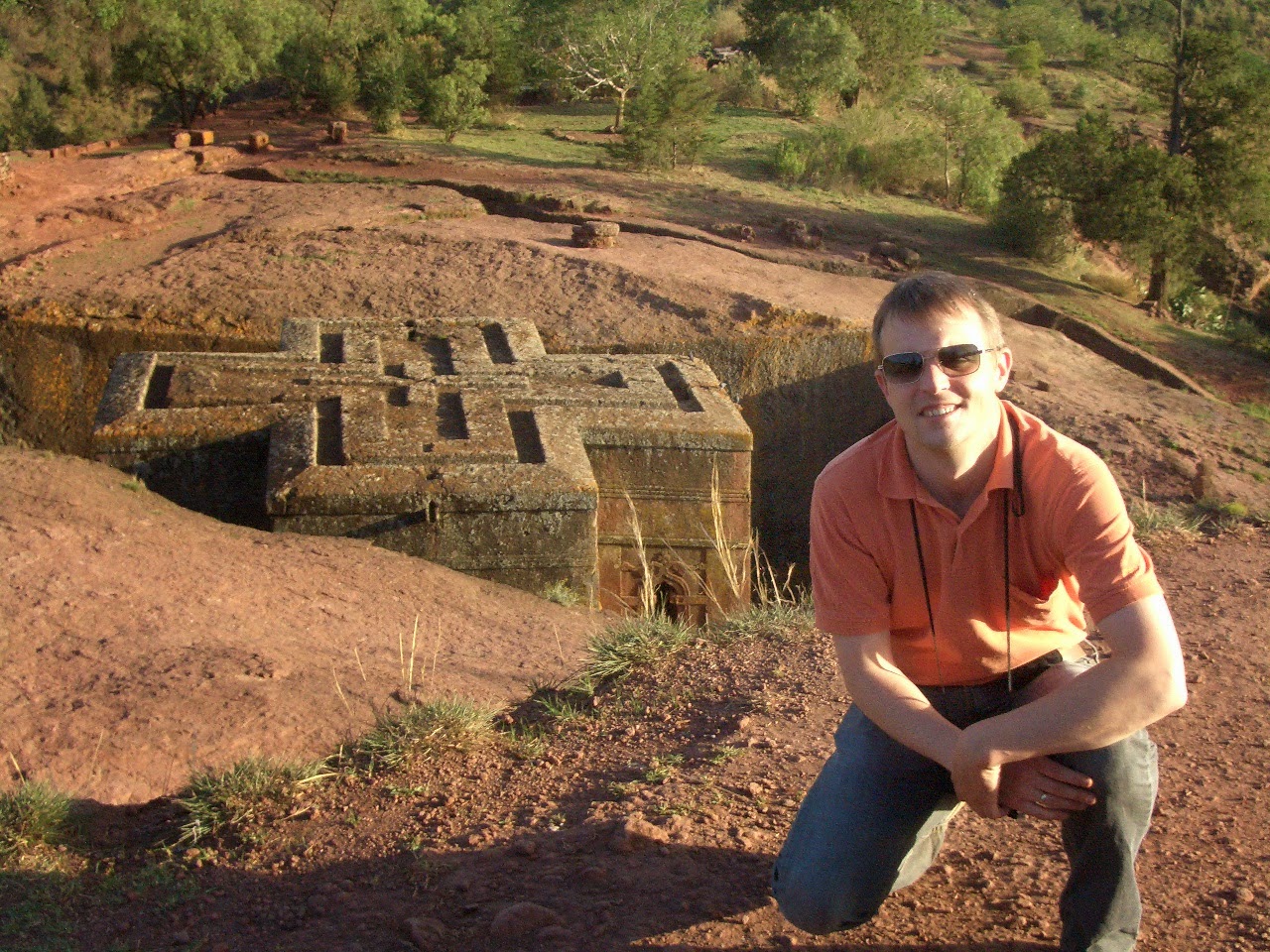
The most famous church, Biet Giyorgis, or the Church of St. George. The church is cruciform, and highly symbolic not just internally, but externally as well there is some reference to Noah's ark.

Side view of St. Georges.

Biet Giyorgis, Church of Saint George.

Biet Giyorgis, Church of Saint George.

Pastor Steve with Biet Giyorgis in the background.

Friday, May 30, 2014

Photos from Lalibella, Ethiopia

As promised, here are some pictures from our time in Lalibella. More pictures will be forthcoming later today, provided we have no more internet problems.

Entrance to the Cave Church of Ymrehane Kristos

Front facade of the Cave Church of Yemrehane Kristos

Carved rock and wood make beautiful designs in the ceiling of the Cave Church of Yemrehane Kristos

Painted archway inside cave church, paint is original from the 12th century.

In the back of the cave church, there are the bones of 5000 faithful people who add to the sacredness of this place, even if it is a bit creepy.

The view from the trail up to the cave church.

The village of Yemhara, below the cave church. This village is over 1000 years old.

External view of one of the Rock Hewn churches in Lalibella.

External view (front facade) of one of the rock-hewn churches of Lalibella.

Lalibella


    Today started out extremely early. Our alarm went off at 4:30 am and we were downstairs ready for breakfast at 5:15. After a healthy and delicious breakfast, we headed off to the airport to catch the morning flight to Lalibella. After about an hour in the air, our plane landed in the city of Gondar. It looked quite beautiful there, so I am excited to return to Gondar after Lalibella and Axum. Our plane took off again and we flew a brief 30 minute flight and landed in Lalibella.
    Lalibella is one of the best known tourist spots in all of Ethiopia. Getting off the plane, I was awed by the mountains around us. There are mountains in Addis Ababa, but the mountains in Lalibella are totally different, less green, terraced farming fields, small villages with round thatched houses. Riding in the van from the airport to our hotel we were blessed with amazing views and beautiful country.
   
Over the past two days we spent in the remote area around Lalibella. This region is well known for the world famous rock-hewn churches. Much of our time was spent touring all of the churches in the area. It is hard to find a word to truly describe what these churches are like.


Each one is different which speaks to when and why they were made. The story goes that King Lalibella (which means honey eater in Amharic) made a journey to Jerusalem and saw the important sites of Christianity and Judaism. It is important to note that Ethiopian Orthodox Christianity is a very unique blend of Christianity and Judaism. Having the Ark of the Covenant (supposedly) on Ethiopian soil has created an almost cultic (not intended to have a negative connotation) belief in the mixture between the two religions. Upon his return from Jerusalem, King Lalibella went about building these churches with each one dedicated to one of the important sites in Jerusalem. They are all highly symbolic. They also occur in three groups, separated by a small waterway symbolizing the Jordan River. As a whole, the churches were built in the twelfth century and it took 23 years to build all thirteen churches. There have been estimates to how many people it would have taken to build all the churches, and they are in the tens of thousands. However, local lore points to the help of Angels who would come at night and continue work through the night. In one church, there is even the legend that King Lalibella's wife carved the entire church herself with the help of the angels at night.


The thirteen churches are all distinct and are varied in layout and design. Many loosely follow a basilica format, yet somewhat altered in that they must still contain the three sections of the church, the outside where hymns and chants are sung, the secondary area where Holy Communion is served to the priests and deacons and the most important, the holy of holies, wherein a replica of the Ark of the Covenant is kept, out of view of all but the head priest.


One of the most amazing experiences took place on the afternoon of our first day there. We were able to enter into one of the larger churches where we were able to sit and listen to the ritual chanting for an hour or so. It was almost time-warping, to sit in this church carved out of a single stone over 800 years ago and listen to the chants of the priests and deacons, accompanied by drums and with the scent of incense thick in the air. To close your eyes and spend some time in prayer was both refreshing and powerfully meaningful. To be in a place so far from home and yet feel so close to God, brings to mind the reality that wherever God “is” is where we are. Distance is a state of mind more than it is a physical reality. We spend our lives trying to get to heaven. A noble task, but in our modern church, maybe a bit misdirected. Rather than trying to live our lives to go somewhere else, maybe we should spend more time working on making that someplace else a reality here. Isn't that what Jesus means when he talks of the Kingdom of God?


There is a reverence here that is refreshing, from seeing the faithful attending church even when it is difficult to do so. Even when there are other demands in life, still they come. Yet, we look for excuses not to attend church, even when it is just one day a week, even when we have nothing better to do. There is a lack of reverence in the US, and I fearit is stifling us. I don’t even necessarily mean a reverence for Jesus Christ, but even just a reverence for the Divine, that essence or spark that is in us and around us, regardless of where we believe it came from. We lack a reverence for our inherent humanity and the connections that unite us into communities of individuals, communities of faith, communities of change and communities that seek to know more and do more and love more and learn more.

From this sacred place, we leave for Axum, the ancient capital of Ethiopia. More from there in a following post.